For the Wearer
If you're reading this, you've probably been thinking about chastity longer than you'd like to admit. The author certainly had. What started as curious browsing in 2008 became something that lived in the back of his mind for two full years before he worked up the courage to say it out loud to his wife. You are not alone in that long stretch of private curiosity, the late-night reading, the imagining, the quiet wondering of what would it actually feel like?
This guide comes from lived experience, including the awkward first conversations, the nights spent adjusting to a device that wouldn't let him forget it was there, and the slow discovery of what actually works in a real relationship versus what sounded good in fantasy. Whether you're considering a device for the first time or trying to understand what you're already doing in a new light, this is from someone who learned the hard way and wouldn't trade any of it.
- Approaching Your Partner
- So Your Partner Wants to Lock You Up?
- Physical Adaptation
- What to Expect
- Fantasy vs Reality
- The Psychological Aspects
- Common Challenges and Solutions
- Communication
- Tips for Thriving as the Wearer
- Your Path Forward
If you're considering this, you're probably feeling a complicated mix of excitement, nerves, and something that might be anticipation or might be fear, and honestly it's hard to tell the difference. The author felt all of that, plus years of wondering if wanting this was "normal" and what his wife would think if he ever found the words.
What you're really considering is a fundamental shift: choosing to redirect all your sexual energy toward your partner instead of keeping the solo outlet you've relied on since you were a teenager. Put more simply, you're thinking about giving up the ability to satisfy yourself whenever you want, and letting her decide when that satisfaction happens. As we'll explore in What to Expect, this brings real challenges: frustration that has nowhere to go, a vulnerability that can feel raw, and the need to navigate conversations you've never had before. But it also brings something else. Every touch becomes more vivid. Every glance from her carries more weight. The wanting itself becomes something you share, a current running between you that changes the way ordinary moments feel.
Approaching Your Partner
If you're like most men considering chastity, you've been thinking about this conversation for months or even years before working up the courage to have it. The author spent two years researching, imagining, and finding reasons to delay before finally approaching his wife in 2010. That long buildup of private wanting mixed with uncertainty plays out across countless stories from men in the same position.
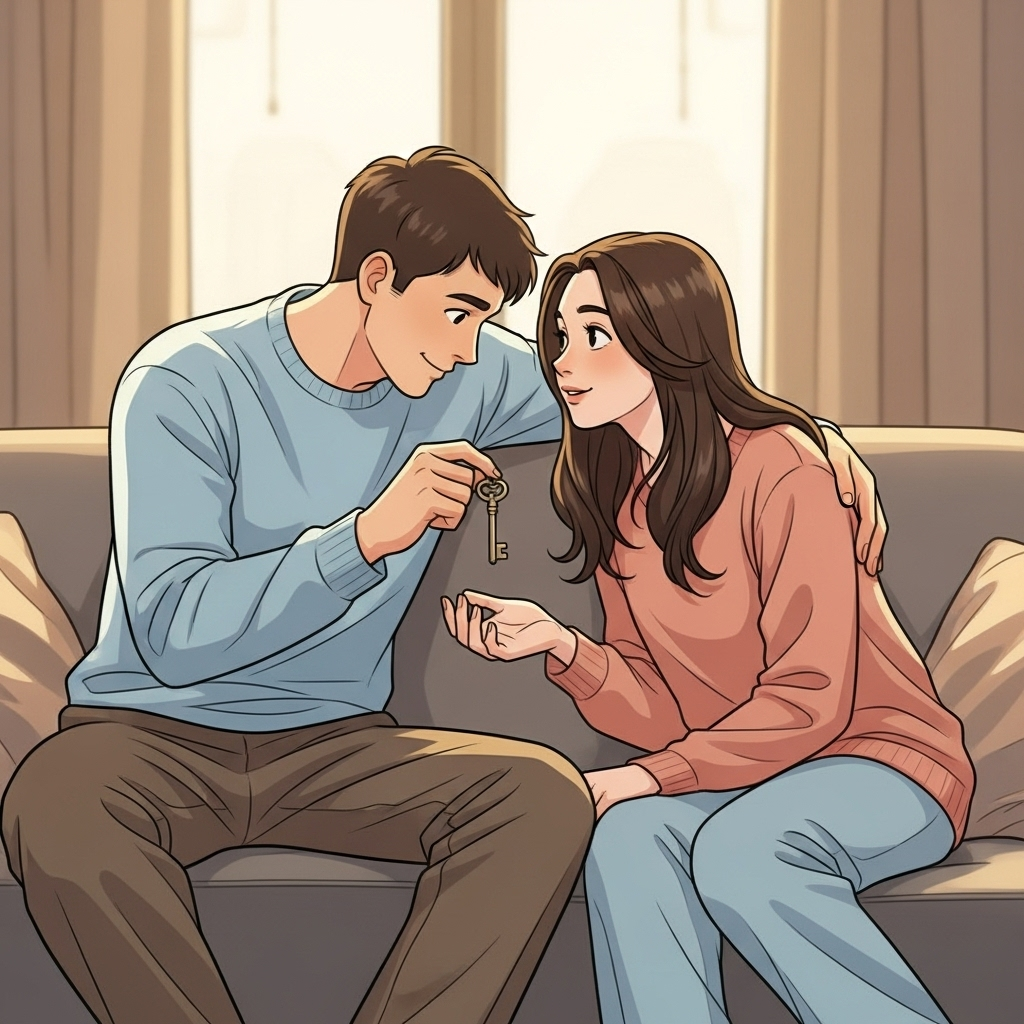
When you finally decide to speak, timing and approach matter. Choose a relaxed evening when you're both comfortable and free from distractions. You might start with something like, "I've been thinking about ways we could deepen our intimacy. I came across something called male chastity, and I'm curious about exploring it together. Would you be open to hearing about it?" Notice this focuses on the relationship, not the device. That distinction often determines how the conversation goes.
Come prepared to share what genuinely draws you. Not the mechanics. The feeling. Maybe it's the idea of channeling all your sexual energy toward her, the anticipation that builds when you can't simply take the edge off, the way you imagine every casual touch becoming electric when release isn't in your hands anymore. Be honest about the hormonal changes that increase bonding, the way it could make her touch feel like something you've never experienced before, or the vulnerability of placing something this intimate in her care.
If she seems hesitant, don't panic. She needs time to process. Suggest exploring this guide together, particularly the keyholder section which addresses concerns partners typically have. Offer to start slowly: maybe just wearing a device for an hour while you're both home, or even talking through what it might be like before any physical commitment. The keyholder's perspective on these conversations can help you both find your way in.
Before bringing up chastity, honestly assess your relationship's foundation. If you're hoping chastity will fix communication problems, revive a dead bedroom, or rebuild broken trust, read the When To Stop section first. Chastity amplifies whatever dynamic already exists. It works best when added to a relationship that's already good, not as medicine for one that isn't.
So Your Partner Wants to Lock You Up?
If your wife or girlfriend brought up chastity and you're here trying to understand what you might be getting into, take a deep breath. Your reaction might range from a surprising jolt of excitement to genuine confusion about what this means for you and your body. All of those responses make sense when someone suggests something that challenges assumptions you've carried your entire life about your own sexual autonomy.
At its heart, chastity is about redirecting your sexual energy entirely toward your partner instead of keeping the solo option you've had since you were a teenager. When masturbation isn't available, something shifts. Every intimate moment becomes more vivid. Every touch from her carries more weight because you can't blunt the edge on your own afterward. The device prevents erections and solo release, yes, but the real change happens in how you experience desire itself. It stops being something you manage privately and becomes something that lives between the two of you. Release is no longer a default you assume is coming. It appears when shared desire is actually there, when she wants it, when the moment is right for both of you.
Your partner likely sees this as a path to a different kind of closeness. The benefits couples discover include more honest communication, more physical affection throughout the day (because you can't stop touching her), and encounters that feel charged in ways routine sex never was. When all that wanting has nowhere to go but toward her, you start noticing things about her you'd stopped seeing. The way she laughs. The warmth of her skin. The look she gives you when she knows exactly what you're feeling.
Wearing a device, particularly for the first time, brings up emotions that collide: arousal and vulnerability, excitement and the sudden awareness that you've handed something over that you can't take back without asking. These conflicting feelings are normal. Communication with your keyholder becomes essential, not just for practical adjustments but for processing these waves together as you both learn what this means for you.
The intimacy works precisely because it requires so much trust. Be prepared for the intensity of delayed gratification: the anticipation can be thrilling, but the loss of control can also feel unsettling until you learn to lean into it rather than fight it. Start slowly, with short periods of just a few hours, and gradually stretch as you become comfortable with both the physical sensation and the psychological shift of needing her permission for something your body is urgently asking for.
Physical Adaptation
The First Days: Physical Adjustment
The first time that lock clicks shut, you'll likely feel a rush of something electric, followed quickly by a "what have I done?" jolt as the reality settles. The device feels foreign: the unfamiliar weight, the way your body tries to respond to arousal and meets resistance, the constant gentle pressure reminding you that something has changed. Most men find wearing becomes surprisingly natural within days or weeks, but don't expect it to feel "normal" immediately. What you will feel, almost right away, is an awareness of your own body that you haven't had since adolescence. Every shift, every accidental brush of fabric, reminds you.
Physically, you'll develop new routines that initially feel awkward. As covered in the health and safety section, you'll need to sit down to urinate, discover new approaches to hygiene, and learn how different clothing fits over the device. These adjustments become second nature faster than you'd expect, but give yourself patience during the learning curve.
Start slowly: a few hours first, then morning to evening if that goes well, then attempt a full 24 hours. Listen to your body. If you experience genuine discomfort beyond normal adjustment sensations, take a break. Early success comes from patience and gradual progression, not from endurance tests.
Nights will likely be your biggest early challenge. Most men experience nocturnal erections that press against the cage, sometimes waking you with a discomfort that's oddly mixed with arousal. You're lying there at 3 a.m., body straining against metal or plastic, and you can't do a thing about it except wait for it to pass. Those first nights can be genuinely difficult. Plan your initial overnight attempts for weekends when you can afford to be tired.
When you do wake from nocturnal pressure, getting up to use the bathroom sometimes helps relieve the attempted erection. Some men find a different sleeping position helps. Others discover that staying cooler reduces nighttime arousal. Expect a learning process, not an immediate solution.
Over days and weeks, additional changes emerge gradually. Many wearers report better focus once the initial device-obsession fades, reduced sexual distraction during the day, and a stronger pull toward their partner's needs. The denial intensifies sensation when arousal does hit: your skin feels more sensitive, her touch registers more sharply, and you find yourself noticing her in ways that catch you off guard with their intensity. These shifts typically develop slowly, but when they arrive, they're unmistakable.
What to Expect
The Mental Shift: From Solo to Shared
Beyond the physical adaptation, expect a psychological shift that runs deeper than the device itself. Something you've controlled since adolescence, your ability to seek release whenever the urge builds, is no longer yours to decide. That loss of autonomy can feel thrilling and unsettling in the same breath. You become dependent on your partner for something as basic as orgasm, and that dependency creates a vulnerability that can make you feel more exposed than you've ever been with another person.
The psychological transition takes time and rests on the trust you've built together. Many wearers find this mental dimension more compelling than anything physical. The anticipation that builds during denial can feel more intense than release itself: a heightened state where her voice, her scent, the brush of her fingers against your arm all hit harder than they have in years. Your attention is forced toward shared intimacy because solo satisfaction simply isn't on the menu.
You may find yourself more attuned to her moods, more eager to please, more aware of opportunities for closeness. Small gestures take on deeper meaning when you can't blunt the edge afterward. A hand on her back. Making her coffee exactly the way she likes it. Noticing when she's had a hard day and stepping in before she asks. Understanding the hormonal shifts behind these changes can help both of you appreciate why attentiveness naturally increases, even when it doesn't feel like a conscious choice.
Chastity does not mean no sex. It shifts how you talk about and decide on intimacy, with release negotiated together rather than assumed. Expect more conversation about timing, desire, and enthusiasm, and see the Unlocking for Sex guidance for keeping shared pleasure front and center.
Fantasy vs Reality
If you're just playing around with chastity, self-locking here and there, a weekend trial, a few teasing hours, you can have a lot of fun. Light, intermittent use delivers novelty and arousal spikes without fundamentally changing your habits. You still know you can masturbate or stop whenever you want, so old patterns stay intact under a new wrapper. That's valid exploration.
The deeper shift described in this guide only lands when being locked is the norm and unlocks are intentional, what this guide calls being default locked. That's when fantasy turns into lived reality: the "I'll just take the edge off" option disappears, and with it the mental safety valve you've relied on for years. What replaces it isn't nonstop erotic bliss. It's a mix of craving waves, occasional irritability, surprising tenderness, and a gradual re-routing of sexual energy toward her because there is nowhere else for it to go. You start reaching for her instead of reaching for yourself.
The practical truth is easy to miss when you're fantasizing: default locked means no solo relief without her awareness and permission, for as long as you both choose to keep this going. That single fact changes everything. It stops being a game and becomes a shared practice with real feelings and real consequences, good and difficult, that show up in everyday life. It no longer depends on your willpower or mood; the structure holds because she holds the key. Letting go of any internal countdown frees you to notice what actually brings her closer, what makes her want you, what makes her eyes change when she looks at you.
Many wearers expect it to feel erotic all the time. The reality is mixed. Some days are electric: she brushes past you and your whole body responds, and she sees it, and something passes between you that makes a regular Wednesday feel dangerous. Some days are flat. Some days the device is just annoying hardware you're tired of cleaning. That doesn't mean it's failing. Devotion deepens over time and moves in cycles. Teasing in fantasy is always delightful, but teasing in reality can feel overwhelming on high-craving days unless you and your keyholder learn each other's signals. And the intensity doesn't necessarily calm down. As hormones shift and the relationship changes (hopefully for the better), the wanting can grow rather than settle.
In reality, logistics like hygiene, sleep disruption, mood swings, and having to ask to be unlocked, sometimes hearing "not yet" when every nerve in your body is asking for relief, compete with the fantasy version you imagined.
Recognizing this gap protects you from quitting before the meaningful benefits emerge, often after a solid, unbroken stretch where masturbation is genuinely off the table (see Masturbation Control and Physiology). Only then does your brain stop quietly negotiating for solo relief and start investing in shared intimacy: more touch, more conversation, more presence that she can feel. That mental quiet lets anticipation feel collaborative rather than a countdown you're enduring alone.
Intermittent play masks those shifts because the solo option still exists, even if it's a few hours away. Default locked removes ambiguity: the default answer to "Can I?" is "not without us talking." That clarity can feel like a mind flip: first a shock, then oddly calming as internal bargaining subsides and you simply... want her. Cleanly. Without negotiating with yourself.
To make the transition work, agree together that locked is the default and that unlocks happen on purpose, for hygiene, medical needs, or shared intimacy. Keep short check-ins every few days so frustration, cravings, and sleep disruption don't snowball into resentment. Plan ahead for the times cravings hit hardest and redirect with a walk, physical closeness, exercise, or writing about what you're feeling. Track the first month so you can see progress that won't be visible day to day. And let your keyholder know when teasing fuels you versus when it tips into overload.
The Psychological Aspects
Emotional Waves: The Highs and Lows
Chastity creates an emotional intensity that can be both thrilling and difficult to sit with. Some days, the anticipation feels electric: every glance from your keyholder sends something through you, every accidental brush of her hand against yours makes your skin feel like it's humming. Other days, frustration builds, especially if you're used to frequent solo release. You might feel a sharp pang of loss for the freedom you've given up, or a restless moment where the urge to touch yourself is strong and the cage is right there, unyielding. What many wearers discover is that this denial can reshape raw desire into something that feels more powerful than simple satisfaction ever did.
These emotional waves are normal and part of what makes chastity work. The key is communicating openly with your keyholder about what you're going through. The keyholder's guide helps her understand and support you through both the charged and the challenging moments.
The Ordinary Days: When "Nothing Happens"
Something rarely discussed: there will be stretches of days, sometimes weeks, when chastity fades into the background. No spark, no constant awareness, no dramatic feelings. Just regular life: work, errands, routine. The device becomes as unremarkable as a watch, and the dynamic nearly invisible. Yet beneath this quiet surface, something subtle stays at work. The gentle dependency that keeps your intimate connection humming, even when everything else pulls you in different directions.
These ordinary periods aren't failure. They're a sign that your practice is becoming integrated and sustainable. You might only remember you're locked when you need the bathroom or during showers, but that subtle restriction, the knowledge that you cannot simply handle things yourself, builds a quiet wanting that simmers beneath the surface. It's this dependency on your keyholder that keeps communication alive, requiring check-ins about needs and desires that might otherwise fade amid busy schedules. And when the spark returns after a quiet stretch, it returns with force. The contrast makes ordinary Tuesday feel like kindling waiting for a match.
When you check in during these times, it's fine to say "Honestly, I barely thought about the cage this week" or "Some days it feels as routine as brushing my teeth." These flat spells are legitimate, and they often provide needed rest from more intense periods. Chastity doesn't demand constant excitement. There's real comfort in the ordinary, and your dynamic is alive even when it's barely noticed. In fact, this quiet phase can make the next wave of wanting hit harder, turning an ordinary evening into something that crackles when she gives you a certain look or lets her hand rest on you a beat too long.
Common Challenges and Solutions
Managing Emotions: Coping with Frustration
 Frustration and restlessness are natural, especially early on or during longer stretches when the absence of solo relief feels most acute.
That's essentially the point of chastity: to create a heightened state of desire and anticipation, and the inability to
do anything about it on your own produces a frustration that's unlike anything else. It sits in your body. It colors how
you see her. It makes a simple "how was your day?" feel loaded when she's the only person who can answer the question
your body keeps asking.
Frustration and restlessness are natural, especially early on or during longer stretches when the absence of solo relief feels most acute.
That's essentially the point of chastity: to create a heightened state of desire and anticipation, and the inability to
do anything about it on your own produces a frustration that's unlike anything else. It sits in your body. It colors how
you see her. It makes a simple "how was your day?" feel loaded when she's the only person who can answer the question
your body keeps asking.
The key is finding healthy outlets without letting frustration overshadow the intimacy you're building. One strategy is mindfulness: a few moments of focused breathing, acknowledging the wanting without judgment. This can ground you when the urge for relief feels overwhelming.
Journaling helps too. Write down what you're feeling, what triggered it, what you notice about how your attention shifts. Sharing parts of this with your keyholder during check-ins can deepen your conversations and give her insight into what's happening under the surface, especially how you're handling the loss of your oldest private habit.
Redirecting energy into non-sexual closeness can turn frustration into connection. Offer her a massage and let your hands move slowly, aware of her skin and your own heightened sensitivity. Plan a quiet evening together. Hold hands during a movie, feeling the warmth of her palm against yours and letting yourself sit in the wanting without trying to fix it. Often you'll find the edge of frustration softening into something warmer when you focus on being close rather than being released.
Building Emotional Resilience: Embracing Vulnerability
Handing over control of your most primal need isn't a small thing. What the author has learned is that allowing yourself to be seen this unguarded can create an intimacy few couples ever reach. Your partner sees you wanting, struggling, needing her in ways you can't hide or manage on your own. That exposure can feel terrifying at first. Over time, many wearers find it becomes a source of quiet pride: the willingness to be this open, this known, this dependent on someone they love.
Consider one wearer who shared: "At first, I felt exposed and weak asking for release, especially after years of handling my own needs. But after a few weeks, I realized my keyholder wasn't judging me. She was cherishing my trust. That vulnerability became our bridge to deeper conversations and a closeness we hadn't had in years." What feels like weakness at the start often becomes the foundation of something stronger. Be patient with yourself, and talk openly with your keyholder about how it feels to need her this way. She'll likely value your honesty more than you realize.
Aftercare: Reconnecting Post-Release
When release finally happens, especially after a long stretch, the rush of physical and emotional intensity can leave you feeling adrift afterward. The wanting that defined your days suddenly drops away, and the quiet can feel disorienting. Aftercare bridges this transition: reconnecting with your keyholder through touch, quiet words, or simply lying together in the stillness after. Many wearers find that locking back up soon after release makes the return easier, with aftercare serving as the bridge between freedom and the familiar feel of the device clicking shut again.
Talk with your keyholder about what you both need in these moments. Sometimes you'll crave physical closeness and reassurance. Sometimes you'll want quiet. Keep talking about what grounds you both, and treat these conversations as part of the intimacy, not separate from it.
Aftercare isn't optional; it's essential for keeping your emotional connection strong, especially in the vulnerable moments after release.
Communication
As the wearer, communication is something you'll need to build deliberately. It starts with practical needs: letting your keyholder know if you need unlocking for hygiene, if the device is causing discomfort, if something doesn't feel right. These routine check-ins are vital. Honest, regular conversations keep your physical health, emotional state, and your relationship in balance. Don't sit on small issues; a minor irritation mentioned early is a quick fix, but ignored it can become a real problem.
Beyond logistics, chastity opens conversations you might never have had otherwise. With your pleasure in her hands, you have a unique opening to explore what brings her joy, what she wants, what makes her feel desired. Ask questions you might have been too comfortable to ask before: "What makes you feel most wanted?" Share things you've kept quiet. The vulnerability is already there; you might as well use it. Exploring concepts like Love Languages can help. Knowing whether she craves words or touch or acts of service lets you channel all that restless wanting into something that reaches her.
When the wanting peaks and you feel like begging for release, consider how you frame it. Instead of "I can't take this anymore," try "I'm really on edge today. Can we spend some time together?" This keeps the focus on closeness rather than demand, building trust instead of tension. She'll feel the difference between a partner who's reaching toward her and one who's just trying to get past her to what he wants.
Tips for Thriving as the Wearer
Keep Communication Central: As explored in the Communication section, share your highs and lows. Tell her when you're buzzing with anticipation and when you're struggling. A simple weekly check-in keeps you aligned with your keyholder and often leads to the kind of honest conversations that draw you closer.
Channel the Frustration: Frustration is inevitable during longer stretches, but it can become fuel for connection. See strategies in Common Challenges. When the wanting peaks, turn toward her instead of inward. That restless energy directed at her, through touch, attention, or simply being present, is part of what makes this work.
Balance Requests with Respect: When desire peaks, the urge to ask for release can feel urgent, but constant pleading can strain your bond. Work with your keyholder to set boundaries around these conversations. Agree to bring up release only during planned check-ins, or find a way to express the wanting that feels playful rather than pressuring. This shows trust in her timing, and often makes the eventual "yes" feel more electric because you waited for it.
Prioritize Hygiene and Fit: A clean device and body are non-negotiable for long-term wear. Follow a daily routine of washing with mild soap in the shower, and don't hesitate to ask for unlocking if you notice irritation. Check the Health and Hygiene section for detailed guidance. Fit matters too. The device should be snug, not painful. Measure carefully and test different sizes if needed.
Embrace "No" as Part of the Experience: Hearing "not yet" when your body is begging can sting. But in chastity, her refusal isn't rejection. It's part of what you both chose. Use that restless energy: surprise her with something thoughtful, offer a massage with no expectation, plan something that shows you're thinking about her instead of just yourself. That redirect builds patience and often deepens the charge between you, making the waiting feel like something you're doing together rather than something being done to you.
Plan for Safety: Always have a backup plan for emergencies. Keep a spare key in a tamper-evident package or a secure spot you can both access for medical issues or urgent needs. See Emergency Removal for details.
Be Patient with Yourself: Chastity reshapes your body, your mind, and your relationship in ways that unfold over weeks and months. Some days the device will be a quiet reminder of what you share. Other days it'll barely register. Some days it'll be the only thing you can think about, and every time she walks past you'll feel it in your chest. Give yourself time. Many wearers report that focus sharpens, closeness deepens, and intimacy becomes something they didn't know was possible. Every step, even the hard ones, is building something between you.
Looking Forward: Growing Together
As you continue, growth happens in ways you won't predict. Communication becomes richer. Non-sexual intimacy deepens. Sexual connection intensifies because every encounter carries the weight of everything that built up to it. Don't be afraid to evolve your practice. What works in month one might need adjustment in month six as your body adapts and your relationship changes. Stay curious about what serves you both, and recognize that her needs may shift along with yours. The keyholder's guide to finding balance offers her perspective on this shared evolution.
Looking Forward
Becoming a chastity wearer is choosing vulnerability, trust, and shared desire over solo satisfaction. You're choosing to let all that wanting live in the space between you and your partner rather than disappearing privately. That choice reshapes things in ways you can't fully imagine until you're living it.
There is no "right" timeline or intensity. Some days feel electric with anticipation, her slightest touch sending something through you that makes it hard to think straight. Some days pass quietly. Both are part of it.
The most important thing you can do is be honest, with yourself and with her, about what you're experiencing. When something feels hard, say so. When frustration builds, share it before it turns to resentment. And when something happens between you that takes your breath away, a look, a touch, a moment where the wanting and the closeness merge into something that feels bigger than both of you, let her know. That honesty is the foundation everything else is built on.
Adapting takes time. The quiet stretches are healthy signs of integration, not problems. If chastity is bringing you closer, if it's making you reach for each other more, if ordinary evenings feel privately charged in ways they didn't before, then it's doing what it's meant to do. And if it ever works against your well-being or your partnership, pause, adjust, or stop. Your relationship comes first. Always.
I'll be honest - my first attempt at bringing this up was awkward and clumsy. I tried to explain it over dinner and ended up sounding like I was asking for permission to buy an expensive toy. My wife looked confused and more than a little concerned. It took several more conversations over weeks, with me stumbling through explanations while sharing articles that didn't really reflect what I wanted from us.
The breakthrough came when I stopped focusing on the mechanics of belts and cages and started talking about what I genuinely wanted: more intimacy, better communication, and sex that felt connected instead of routine. I had to acknowledge, first to myself and then to her, that I'd been handling my own needs through masturbation in ways that drained energy that should have been flowing toward her. I wanted to change that pattern. I wanted all of that wanting to be hers.
Once she understood it wasn't about taking something away from our relationship but redirecting everything back toward her, everything shifted. But it took multiple conversations and a lot of patience on her part, and re-thinking on mine. Hopefully, this guide can help you have that conversation with more clarity than I managed.